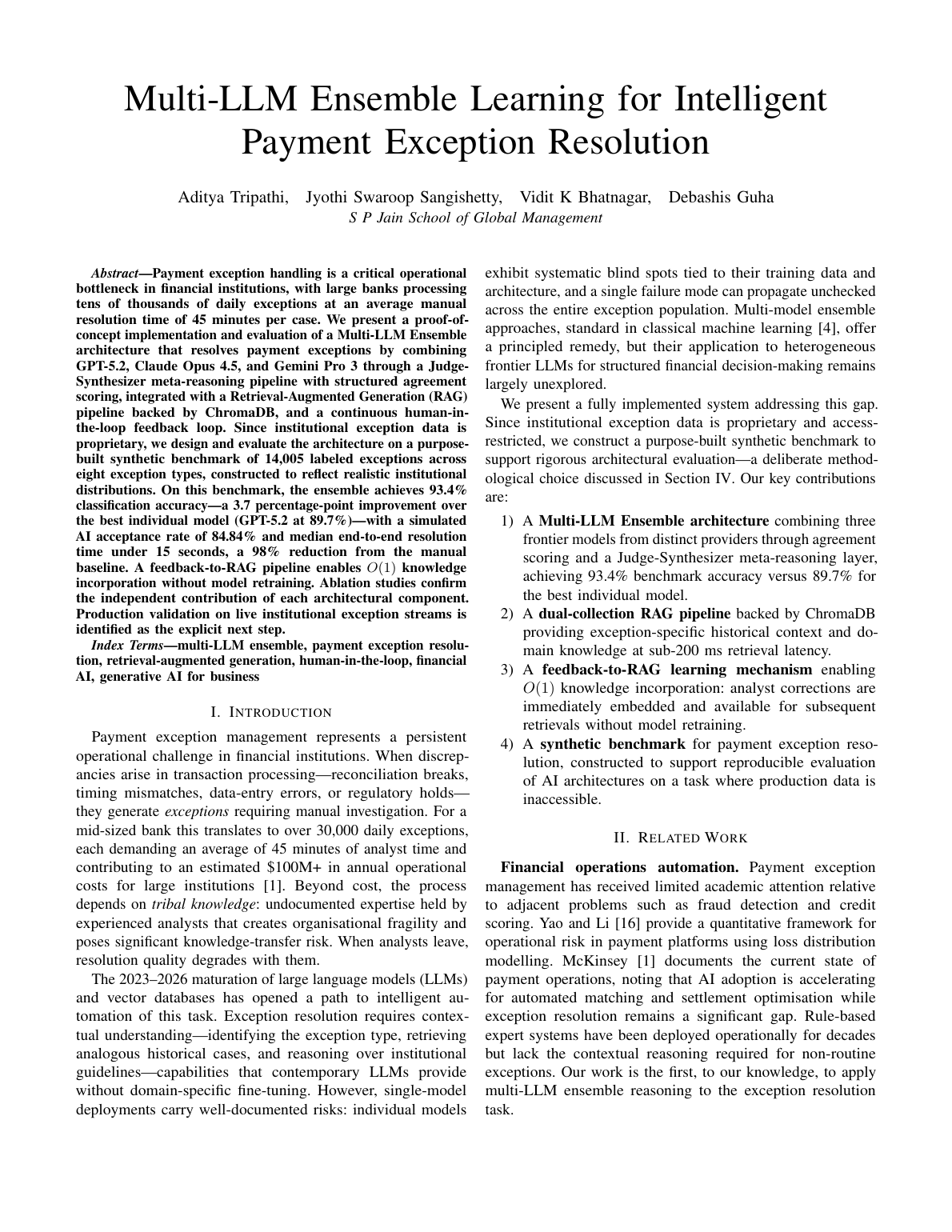
Submitted to AIxB 2026, this paper was co-authored by Aditya Tripathi, Jyothi Swaroop Sangishetty, Vidit K Bhatnagar and Debashis Guha at S P Jain School of Global Management. It explores how an AI system could help analysts investigate payment exceptions. It is a research proof of concept, not a report of performance in a live bank.
The question
Payment exceptions arise when records do not reconcile: dates, amounts, fees or entries may not match. Resolving them can require context from earlier cases, operational rules and an analyst's judgment. The research asks whether multiple language models, working with retrieved evidence, can support more consistent recommendations than one model alone.
The system
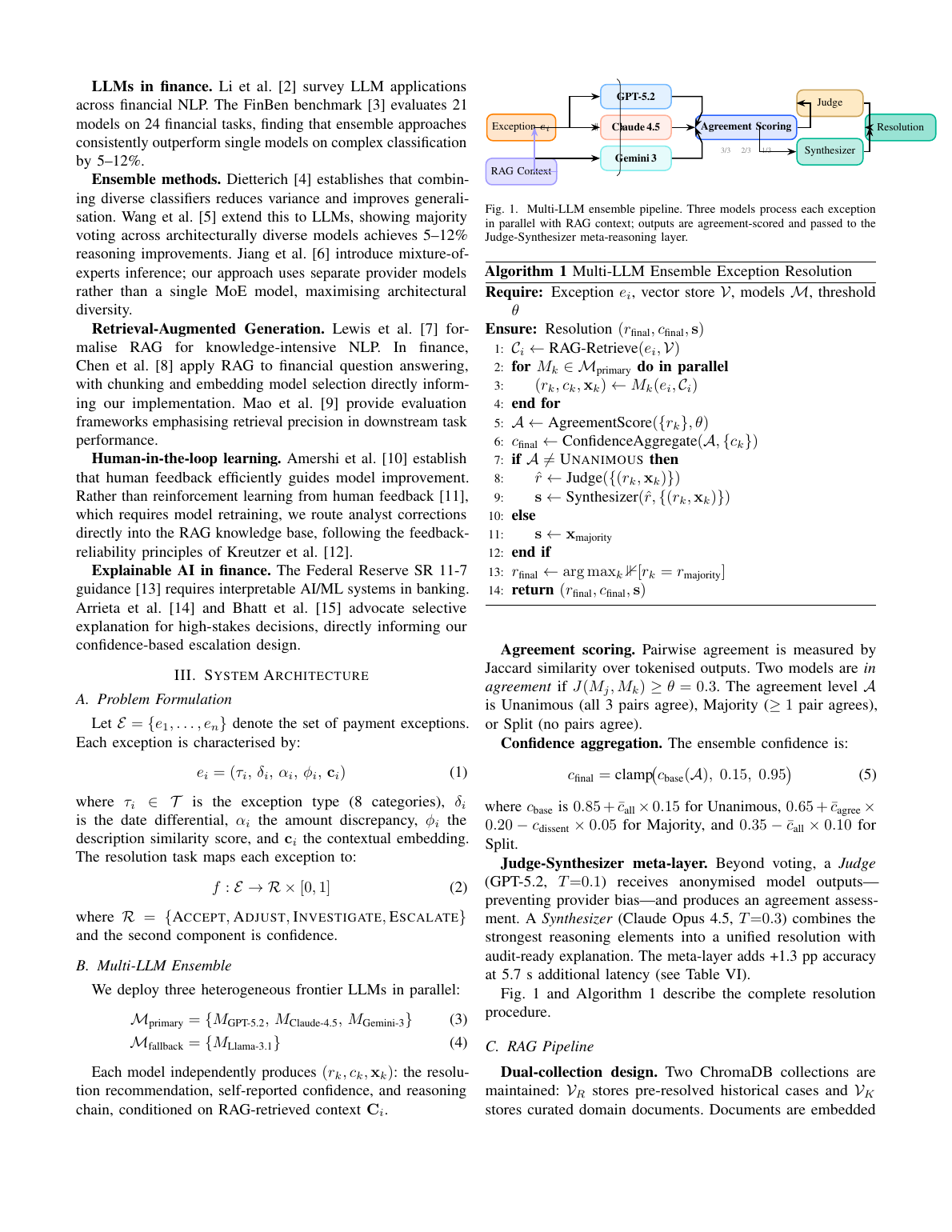
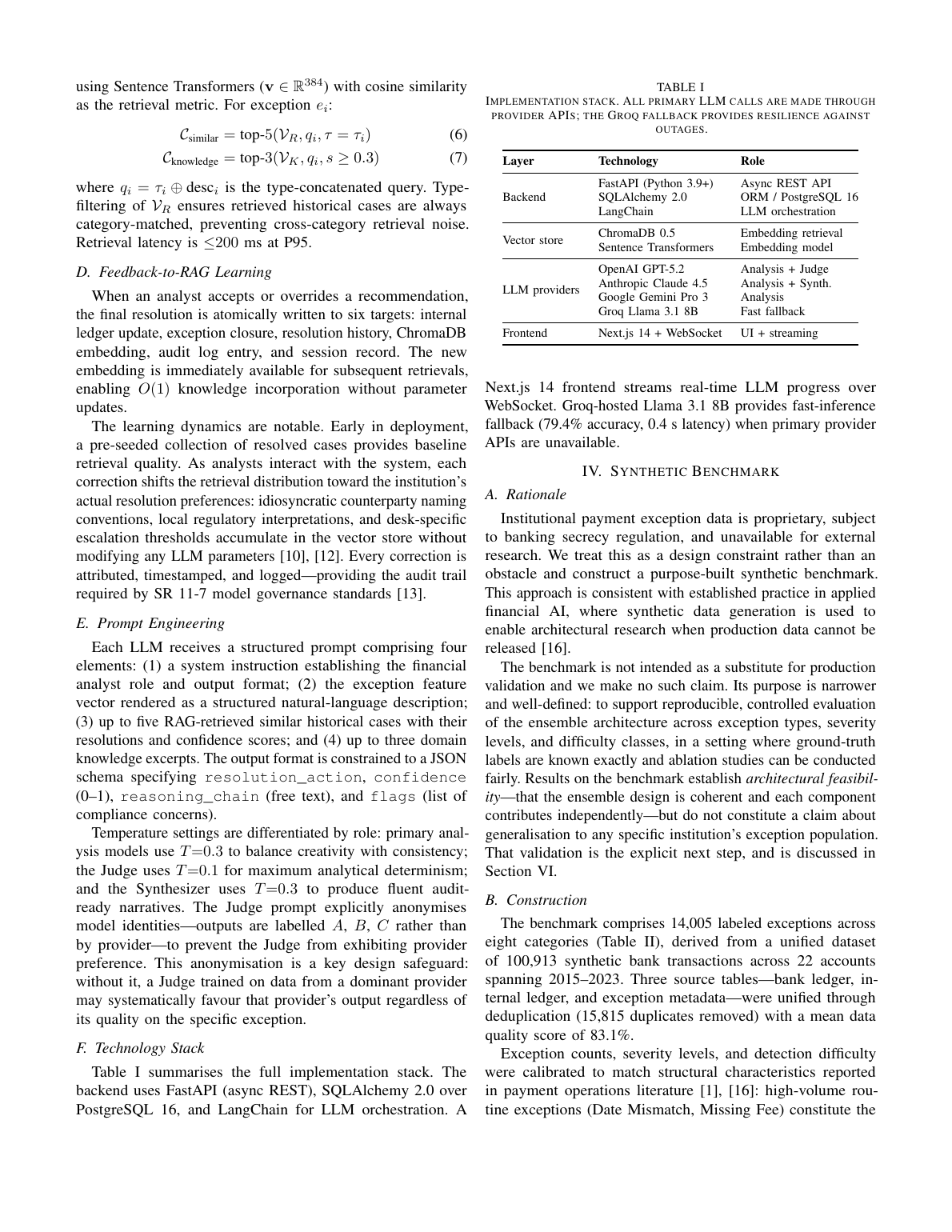
Three models examine each exception in parallel. Their recommendations are compared, and a Judge-Synthesizer layer combines the reasoning when they disagree. A retrieval pipeline supplies similar resolved cases and domain guidance. Analyst corrections are added to the retrieval store for future cases without retraining the models.
What the benchmark showed
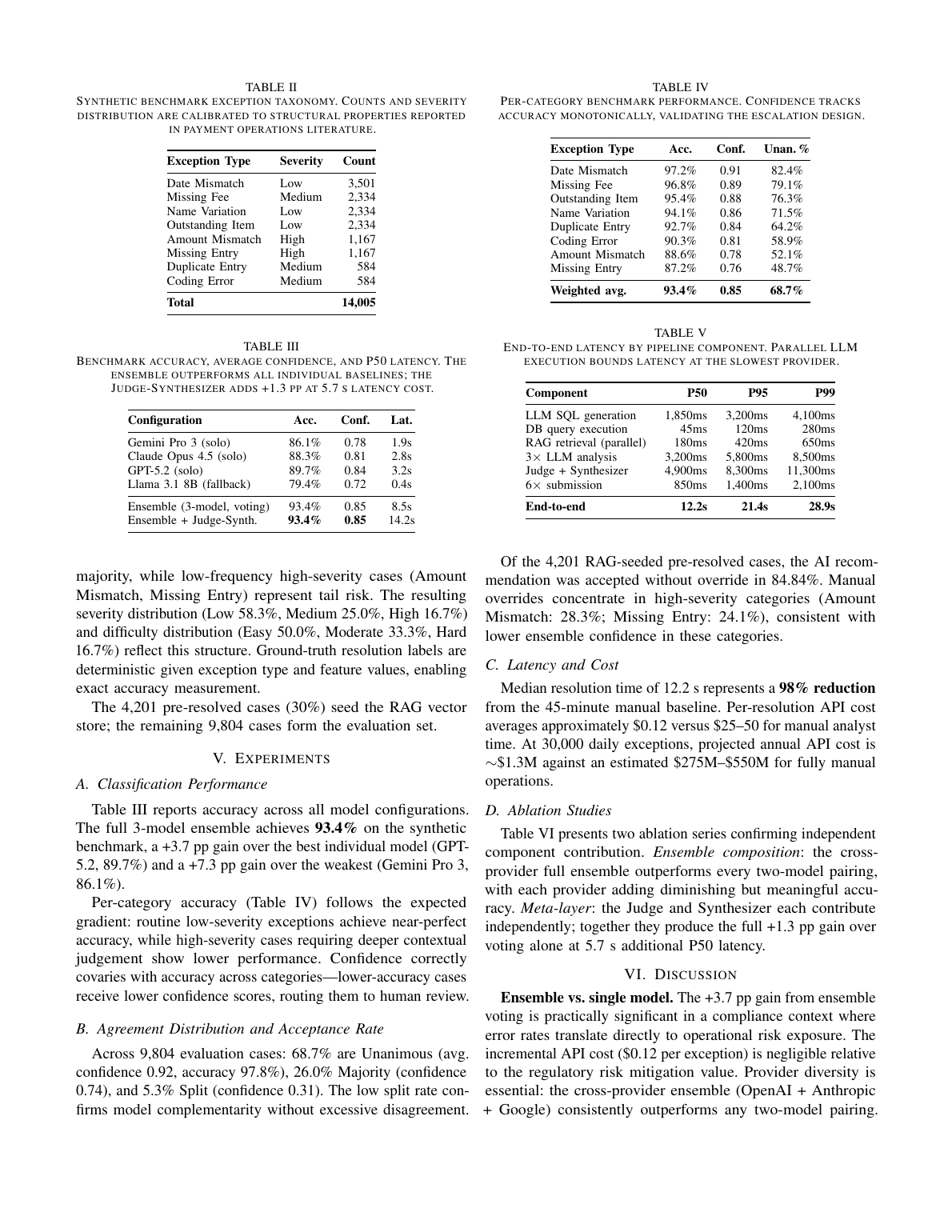
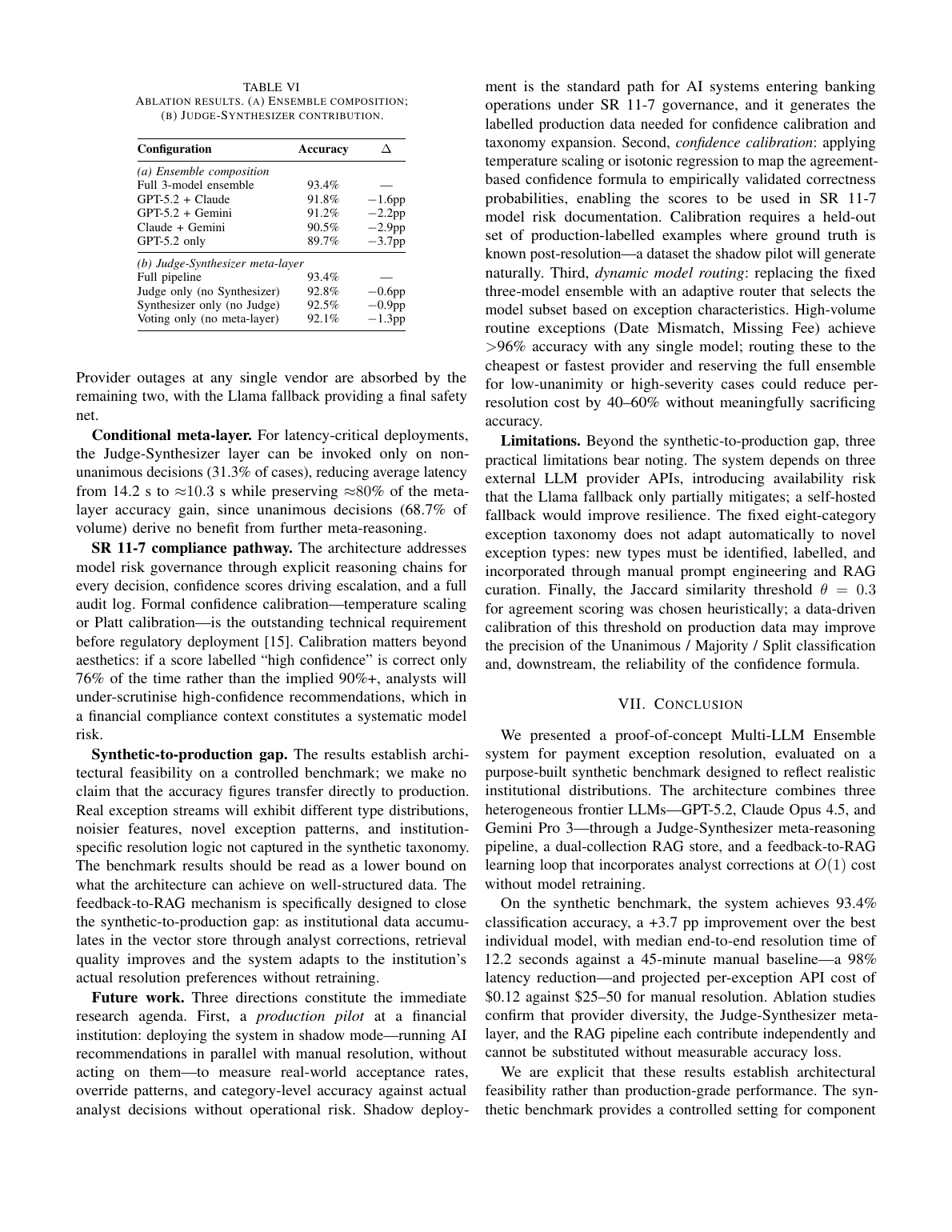
The authors evaluated the architecture using 14,005 labelled synthetic exceptions across eight categories. On that controlled benchmark, the ensemble reached 93.4% classification accuracy, compared with 89.7% for the best individual model. The paper reports a median end-to-end time of 12.2 seconds in its evaluation. These are benchmark results, not production outcomes.
The next test
Synthetic data can test the architecture, but cannot establish how it will perform on an institution's live exception stream. The paper proposes a shadow-mode pilot alongside human analysts, followed by confidence calibration and model-risk review, before any operational use.